AI-Powered Personalization: Tools, Strategies & Applications
Explore AI-powered personalization in 2026, including tools, strategies, applications, benefits, and challenges for better engagement and sales.
Published on 03 Feb 2026
The Ultimate Guide to AI-Powered Personalization: Tools, Strategies & Applications
In the technological era, customers expect experiences that feel personal and relevant to them. Businesses use AI-powered personalization to improve user satisfaction, increase engagement, and drive measurable growth. This guide explains the tools, strategies, applications, and benefits that help businesses stay competitive in modern markets.
Why Personalization Is Important for Business
Personalization has developed from recommendation engines to smart systems to predict customer needs. Personalized experiences are more likely to raise the level of engagement, loyalty and revenues, whereas generic messaging is unlikely to do this.
AI personalization allows companies to:
- Understand user preferences.
- Predict user actions and needs.
- Deliver real-time content, products, and offers.
Example: A travel website suggests destinations based on a user’s previous bookings rather than showing only popular destinations.
How Does AI Personalization Work?
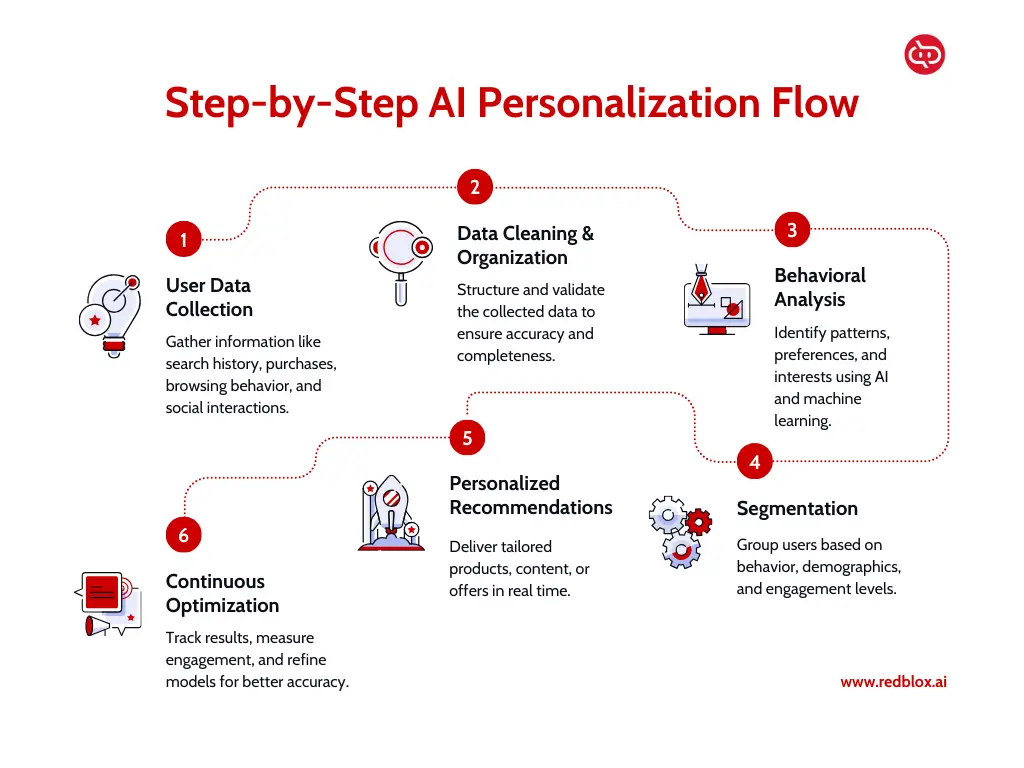
AI-powered personalization works by combining data, analytics, and machine learning to generate user-specific experiences.
Core Components:
Data Collection: Collects user activity data such as browsing behavior, purchase history, searches, device usage, and interactions.
Behavioral Analysis: Identifies behavior patterns and preferences to understand user intent.
Segmentation: Divides users into groups in order to carry out targeted campaigns.
Real-Time Recommendation: Dynamically offers products, services, and content based on interactions.
Real-Life Examples:
E-commerce: Online stores use AI to recommend products a customer is most likely to purchase next.
Media Platforms: Streaming media suggest videos or radio stations based on user preference.
Education: Online learning platforms recommend courses based on a learner’s progress and performance.
Challenges of AI Personalization
There are also distinct challenges to the implementation of AI-powered personalization:
Inconsistent/Incomplete Data: Low-quality data provides inaccurate recommendations.
Complexity of Integration: It is challenging to align AI tools with existing CRMs, websites, or content platforms.
Privacy Issues: In line with GDPR, CCPA, and others, it is necessary to follow transparent practices.
Cost and Technical Expertise: The implementation of AI needs infrastructural and human resources.
Over-personalization risk: Too many recommendations can overwhelm or frustrate users.
Advantages of AI Personalization
Implementing AI personalization tools benefits users and companies.
Enhanced User Experience:
- Individualized recommendations make users feel understood.
- User-focused campaigns typically deliver higher ROI.
- The content is adjusted to personal tastes, which makes it more satisfying
Revenue and Engagement:
- Specific recommendations result in increased conversions and cross-sells.
- Operational Efficiency:
- AI personalization is automated on a large scale, saving labor.
- Performance data provides insights that support broader business decisions.
Example: Retailers that apply AI-based recommendations achieve an increase in sales per visitor.
Selecting the right AI Personalization Tools
When it comes to AI personalization, it is preferable to select effective tools that result in a seamless implementation process and quantifiable outcomes.
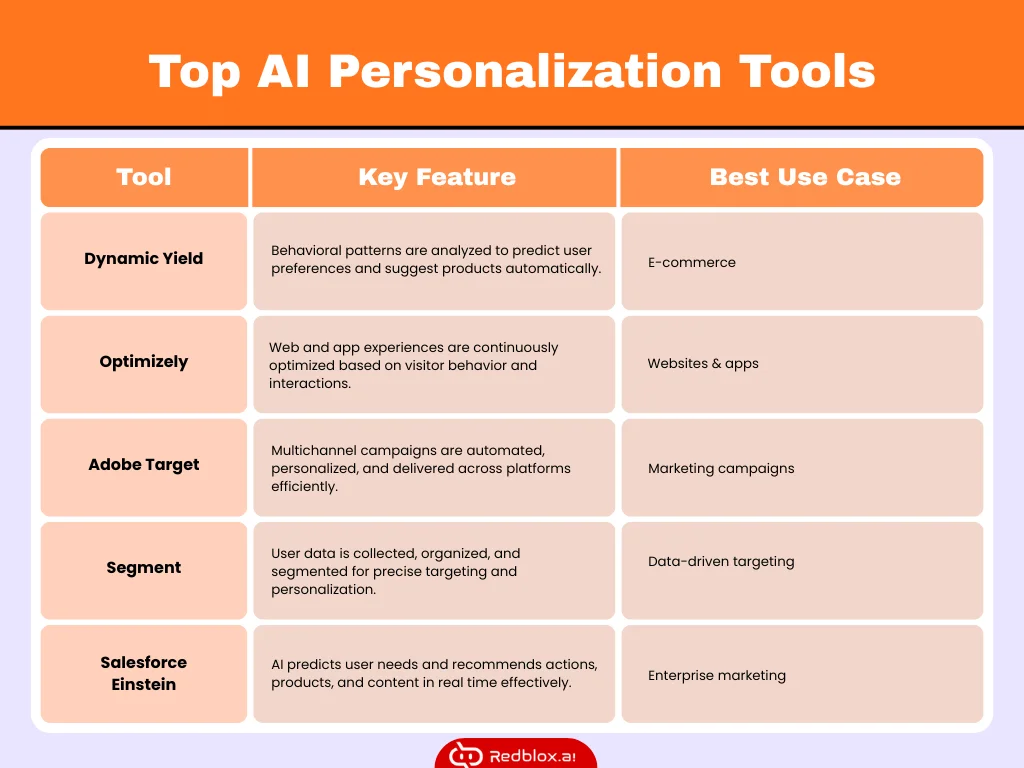
Popular Options:
Dynamic Yield: Behavioral recommendations and analytics.
Optimizely: AI-powered Web and app personalization.
Adobe Target: Multichannel automated recommendations.
Segment: Customer data collection and audience segmentation for accurate targeting.
Salesforce Einstein: Predictive analytics in order to recommend content, products, and actions.
Best AI Personalization Strategies
AI-powered personalization can be successful when it is driven by a clear strategy.
Data Consolidation:
Understand users in terms of behavior, transaction, and demographic data.
Intelligent Segmentation:
Target campaigns based on the interests, behavior, and age of users.
Predictive Modeling:
Apply AI to predict the needs of users and propose the next steps.
Continuous Optimization:
Track the measures of engagement and modify the recommendations.
Transparent Practices:
Display the use of data in a clear manner to maintain user trust and transparency.
AI insights are most effective when combined with human creativity and judgment.
Applications across industries
AI-powered personalization is used across many industries to deliver tailored customer experiences.
Retail & E-Commerce:
- Product recommendations based on browsing and purchase history.
- Customized offers, prices, and promotions.
- Personalized email campaigns with relevant recommendations.
E-commerce personalization, which is driven by AI, increases repeat purchases and minimizes cart abandonment.
Marketing & Content Delivery:
- Individualized push notifications and newsletters.
- Advanced ad targeting and increased ROI.
- Recommendations of curated content.
AI-powered personalization ensures campaigns reach the right audience at the right time.
Media & Entertainment:
- Streaming sites recommend shows, movies and playlists based on preferences.
- Content feeds are dynamically adjusted based on user behavior and engagement.
Education:
- Learning materials and courses tailored to student performance and progress.
- Adaptive learning assists in enhancing retention and results.
Healthcare:
- Individualized medication and wellness reminders.
- AI supports patient engagement through personalized treatment plans and reminders.
Travel & Hospitality:
- Recommends destinations, hotels, and activities based on past behavior and preferences.
- Improves customer satisfaction by offering customized offers and itineraries.
Impact of AI Personalization
Measuring AI-powered personalization is an important parameter to guarantee ROI.
Metrics include:
Conversion Metrics:
Tracks purchases or sign-ups influenced by AI-driven recommendations
Example: An online bookstore realizes that customized recommendations of related books are able to boost checkout conversion rate by 15%.
Engagement Metrics:
Time spent on the platform, number of clicks and interactions with personalized content.
Example: A news portal will record longer session times when articles are suggested using AI.
Retention Metrics:
Users who engage with AI content personalization visit it repeatedly or subscribe.
Example: In a learning platform that is offered on a subscription basis, the retention rates are increased when courses are customized to the progress of the learner.
Campaign ROI:
Compare AI-powered campaigns with generic campaign performance.
Example: A retailer can monitor the revenue of AI-personalized mailing in comparison to mass emailing to measure the impact.
The New Trends of AI Personalization
Within AI-powered personalization, technology changes fast. Some trends to watch include:
Hyper-Personalization: Based on in-depth data such as micro-behaviors, time of day and place, highly targeted suggestions can be made.
Omnichannel Integration: Making sure that there is consistency in personalization on websites, apps, email, and social media.
Voice and Visual Customization: Suggesting products by reference images or voice.
Ethical AI: How to make AI recommendations with privacy and fairness in mind.
Predictive Engagement: Predicting customer needs and offering solutions before users actively make a request.
Avoiding Common Mistakes
- Introducing AI personalization without a strategy.
- Disregarding privacy laws and codes of ethics.
- Overloading users with too many recommendations, which can cause fatigue or frustration.
- Failure to monitor and refine AI models on a regular basis.
The Future of AI Personalization
In the future, AI personalization will change.
More specific and granular: The advice will be addressed to micro-behaviors and situational indicators.
Immersive: AR/VR will enable personalized experiences, which are interactive.
Proactive: AI will anticipate the needs of the users and take action even before any requests are received.
Ethical and open: The personalization trade-off between privacy and trust.
Implication: AI can be used in future retail stores to greet frequent shoppers by name, recommend products they are likely to purchase, and change in-store offers dynamically based on previous behavior.
Conclusion
With the help of the right AI personalization tools, approaches, and applications, organizations can provide experiences that seem truly personal, receive engagement, and create enduring customer loyalty. Companies that adopt AI today will prosper tomorrow.
FAQ
1. What is AI personalization, and how does it work?
AI personalization uses customer information such as purchase and browsing history to forecast interests and show customized content, recommendations, and deals in real time.
2. What are the best AI personalization tools for businesses?
Adobe Target, Dynamic Yield, Segment, Optimizely, and Salesforce Einstein are popular and can be used to analyze data, automate and create a personalized experience.
3. How does AI personalization improve customer experience and sales?
It displays pertinent materials and products, enhances interactions, elevates conversions, raises the value of orders, and creates customer loyalty.
4. What are the challenges and risks of using AI personalization?
Data quality problems, privacy compliance, complexity in integrating, algorithm bias and over-personalization are among the challenges.
5. How is AI personalization used in e-commerce and marketing?
It tailors product recommendations, advertisements, emails and Web content to enhance targeting, interaction and purchases.
6. What are the future trends in AI personalization?
Hyper-personalization, omnichannel delivery, voice, ethical AI, and predictive recommendations are some of the trends.